Tenses help us explain when an action happens. They allow speakers and writers to describe routines, ongoing activities, completed events, past experiences, and future plans clearly. Understanding the Types of Tenses in English gives students a strong foundation for forming meaningful sentences and communicating confidently.
What Are Tenses in English Grammar?
A Tense in Grammar is the form of a verb that indicates the time of an action, event, or state. For example, “I study” refers to the present, “I studied” refers to the past, and “I will study” refers to the future. The verb changes according to the time being described.
Why Tenses Are Important in Speaking and Writing
The English Grammar Tenses make communication clear by helping listeners and readers understand when something happened. Incorrect tense use can confuse the meaning of a sentence. For instance, “She visits Delhi yesterday” is incorrect because “yesterday” requires the past-tense form “visited.”
Understanding the Three Main Types of Tenses
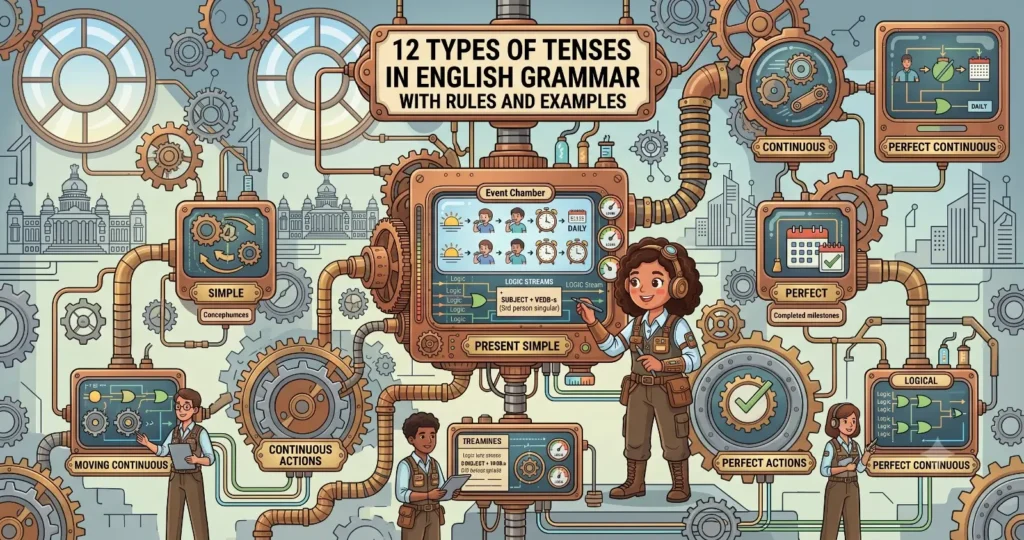
The 12 Types of Tenses are organised under three main time categories:
* Present Tense: Describes current actions, routines, and facts.
* Past Tense: Describes actions that happened earlier.
* Future Tense: Describes actions expected to happen later.
Each category has four forms: simple, continuous, perfect, and perfect continuous.
Four Types of Present Tense with Examples
Learning Tenses with Examples helps students understand how verb forms change according to meaning.
1. Simple Present: She reads every evening.
2. Present Continuous: She is reading now.
3. Present Perfect: She has read the chapter.
4. Present Perfect Continuous: She has been reading for an hour.
Simple Present Tense and Its Uses
The simple present tense describes routines, habits, general truths, instructions, and repeated actions. The Tenses Rules require s or es with singular third-person subjects.
Structure: Subject + base verb/verb with s or es + object
Examples:
- I play badminton daily.
- He plays badminton daily.
- The Sun rises in the east.
Present Continuous, Perfect, and Perfect Continuous Tenses
The continuous form describes an action happening now. The perfect form shows a completed action connected with the present. The perfect continuous form describes an action that began earlier and is still continuing.
- Present Continuous: They are preparing a project.
- Present Perfect: They have completed the model.
- Present Perfect Continuous: They have been working since morning.
Four Types of Past Tense with Examples
Strong English Grammar for Students should include clear comparisons between past-tense forms.
1. Simple Past: Ravi visited Mysuru.
2. Past Continuous: Ravi was travelling by bus.
3. Past Perfect: Ravi had reached before noon.
4. Past Perfect Continuous: Ravi had been travelling for three hours.
Simple Past, Past Continuous, and Perfect Forms
The simple past describes a completed action. Past continuous describes an action in progress at a particular past time. Past perfect shows that one action happened before another past event. Past perfect continuous emphasises the duration of an earlier activity.
Example: “The students had completed the test before the bell rang.” The first action uses past perfect because it happened before the second past action.
Four Types of Future Tense with Examples
Understanding English Grammar Rules for future forms helps students describe plans, predictions, ongoing future actions, and expected completion.
1. Simple Future: I will attend the programme.
2. Future Continuous: I will be attending the programme.
3. Future Perfect: I will have completed the task by Friday.
4. Future Perfect Continuous: I will have been studying for three hours by 8 p.m.
Simple Future, Future Continuous, and Perfect Forms
The Simple Future Tense expresses decisions, predictions, promises, or actions expected to occur in the future. It is usually formed using will followed by the base form of the verb. For example, “She will attend the meeting tomorrow.”
The Future Continuous Tense describes an action that will be in progress at a particular time in the future. It is formed using will be followed by the verb ending in -ing.
For example, “They will be studying at 8 p.m.”
The future perfect forms show actions connected to a specific future time. The Future Perfect Tense describes an action that will be completed before a particular time, as in “He will have finished the project by Friday.” The Future Perfect Continuous Tense focuses on the duration of an action continuing up to a future point, as in “She will have been teaching for ten years by next June.”
Complete List of 12 Tenses with Sentence Structures
The following Tenses Formula table gives a quick guide to all twelve forms. Here, V1 means the base verb, V2 means the past form, and V3 means the past participle.
| Tense | Basic Structure | Example |
| Simple Present | Subject + V1/V1+s | She writes neatly. |
| Present Continuous | Subject + is/am/are + V1-ing | She is writing. |
| Present Perfect | Subject + has/have + V3 | She has written. |
| Present Perfect Continuous | Subject + has/have been + V1-ing | She has been writing. |
| Simple Past | Subject + V2 | She wrote yesterday. |
| Past Continuous | Subject + was/were + V1-ing | She was writing. |
| Past Perfect | Subject + had + V3 | She had written. |
| Past Perfect Continuous | Subject + had been + V1-ing | She had been writing. |
| Simple Future | Subject + will + V1 | She will write. |
| Future Continuous | Subject + will be + V1-ing | She will be writing. |
| Future Perfect | Subject + will have + V3 | She will have written. |
| Future Perfect Continuous | Subject + will have been + V1-ing | She will have been writing. |
Common Mistakes Students Make While Using Tenses
Students sometimes mix time expressions with incorrect verb forms. They may write “I have seen him yesterday” instead of “I saw him yesterday.” Other mistakes include forgetting helping verbs, using V2 after “did,” and confusing “since” with “for.”
Remember:
- Use “since” for a starting point: since Monday.
- Use “for” for a duration: for three days.
- Use V1 after “did”: Did she go?
- Use V3 after has, have, or had.
Easy Exercises and Tips to Master English Tenses
Regular Grammar exercises help students recognise time clues and choose correct verb forms. While solving a sentence, first identify the time, then decide whether the action is simple, continuing, completed, or continuing over a period.
Learning Tenses Through Classroom Practice
The best icse schools in Bangalore can make tense learning easier through storytelling, role play, diary writing, picture descriptions, and sentence-building games. These activities allow students to use grammar in meaningful situations rather than memorising rules alone.
The top ICSE schools in Bangalore also encourage regular reading because books expose students to correct verb patterns naturally. Students can underline verbs in a paragraph and identify whether each action belongs to the present, past, or future.
Parents searching for the best schools in rt Nagar Bangalore may consider how schools develop language skills through reading, writing, speaking, listening, and continuous grammar practice. A strong language environment helps children express their ideas clearly across subjects.
Building Strong Grammar Skills Through the 12 Types of Tenses
Understanding the 12 types of tenses in English grammar with rules and examples helps students communicate clearly and accurately in both speaking and writing. At Presidency School RT Nagar, learners are guided to understand present, past, and future tenses—including their simple, continuous, perfect, and perfect continuous forms—through clear explanations, relatable examples, interactive exercises, and regular sentence practice. This concept-based approach helps students identify time and action correctly, avoid common grammatical errors, and develop confidence in forming meaningful sentences. With experienced teacher guidance and engaging classroom activities, Presidency School RT Nagar helps students build strong grammar foundations for academic excellence and effective English communication.
Conclusion
Tenses form the backbone of English sentence construction. Once students understand present, past, and future time, the twelve forms become easier to recognise. Learning structures, observing time clues, reading regularly, and practising sentences can help students use tenses accurately in conversations, assignments, and examinations.