Parents evaluating the ICSE Board often appreciate its detailed subject coverage, emphasis on English and balance between examinations and practical work. Understanding its structure can help families decide whether it complements their child’s interests and learning style.
What Is the ICSE Board?
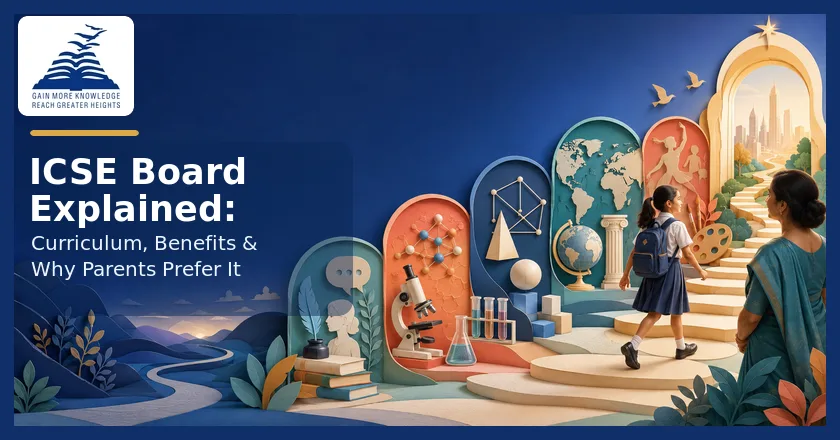
The ICSE full form is Indian Certificate of Secondary Education. It is the Class 10 examination conducted by the Council for the Indian School Certificate Examinations after a ten-year school course.
Understanding the Difference Between CISCE and ICSE
CISCE is the council that conducts examinations, while ICSE refers specifically to its Class 10 certificate examination. Although “ICSE board” is commonly used, CISCE is the governing organisation.
How the ICSE Curriculum Is Structured
The ICSE Curriculum organises Class 10 subjects into three groups. Students generally take the compulsory subjects, selected academic electives, an application-oriented subject and Socially Useful Productive Work and Community Service.
Group I: Compulsory Subjects
Group I includes English, a second language, and History, Civics and Geography. These subjects provide essential foundations in language, culture, citizenship and social understanding.
Group II: Elective Academic Subjects
Students select subjects such as Mathematics, Science, Economics, Commercial Studies, Environmental Science, or an eligible language, depending on the options provided by their school.
Group III: Skill-Based and Application-Oriented Subjects
Options may include Computer Applications, Art, Performing Arts, Physical Education, Yoga, Robotics and Artificial Intelligence, Commercial Applications and other vocational subjects. Availability varies by school.
Key Features of the ICSE Curriculum
The ICSE syllabus combines detailed academic content with internal assessment, project work and subject choices. This approach encourages students to understand ideas and apply their learning.
Comprehensive and In-Depth Subject Coverage
Topics are explored systematically, helping learners build detailed knowledge and understand the connections between concepts rather than studying isolated facts.
Strong Emphasis on English Language and Literature
English Language develops grammar, composition and comprehension, while Literature introduces poetry, prose and drama. Together, they strengthen reading, interpretation and written expression.
Equal Importance to Science, Mathematics, Languages and Humanities
Students receive broad exposure to scientific reasoning, numerical ability, languages and the social sciences, supporting well-rounded academic development.
Practical Learning Through Projects and Laboratory Work
Experiments, field-based assignments, projects and internal assessments allow students to investigate topics and connect classroom theories with observable situations.
Flexible Subject Choices Based on Student Interests
The subject-group system offers some flexibility, although actual choices depend on school resources, teacher availability and permissible combinations under CISCE regulations.
How Does ICSE Learning Differ from Other Boards?
ICSE is often associated with extensive language learning, detailed subject treatment and substantial project work. However, teaching quality can differ significantly between schools following the same framework.
How Students Are Assessed in the ICSE Curriculum?
Assessment combines external examinations with school-based evaluation. According to the official website the balance differs across subject groups.
Written Examinations and Internal Assessments
Most Group I and Group II subjects carry 80% external-examination weightage and 20% internal-assessment weightage.
Projects, Practicals and Application-Based Evaluation
Group III subjects generally follow a 50% external and 50% internal structure, placing greater value on practical performance and continuous participation.
What Are the Benefits of the ICSE Curriculum?
The benefits of ICSE board education can include stronger language proficiency, comprehensive subject knowledge, independent thinking and opportunities to demonstrate learning beyond written examinations.
Develops Strong Communication and Writing Skills
Regular essays, comprehension exercises, presentations and literature-based discussions help students express complex ideas with clarity and confidence.
Promotes Conceptual Understanding Over Rote Learning
Projects, practical exercises and analytical questions encourage students to understand the reasoning behind a concept instead of depending entirely on memorisation.
Strengthens Critical Thinking and Problem-Solving Abilities
Students interpret information, compare viewpoints, solve numerical problems and support conclusions with logical explanations.
Encourages Creativity, Research and Independent Learning
Assignments often require learners to collect information, organise findings and present original work, developing responsibility for their learning.
Supports Balanced and Holistic Student Development
Academics are complemented by arts, physical education, community service and school-based activities that support personal and social growth.
Builds a Strong Foundation for Higher Education
Detailed subject learning and consistent writing practice can support the transition to senior secondary education and academically demanding degree programmes.
Why Do Parents Prefer the ICSE Board?
Parents considering good ICSE schools in Bangalore may value the combination of English proficiency, subject depth, practical exposure and opportunities across academics and creative disciplines.
Broad Academic Exposure Across Multiple Disciplines
Students study languages, sciences, humanities and skill-oriented subjects, allowing them to recognise their strengths before making specialised academic choices.
Greater Focus on Practical Knowledge and Real-World Applications
Laboratory work, projects and application-based subjects help learners see how academic concepts relate to everyday situations.
Strong Preparation for Competitive and International Education Pathways
Strong conceptual and English-language foundations can be useful, but students preparing for specific entrance examinations may still require syllabus-aligned practice.
Opportunities to Explore Academic and Creative Interests
Families comparing the top ICSE schools in Bangalore should examine whether schools provide meaningful choices in sports, technology, literature, visual arts and performance.
Is the ICSE Curriculum Difficult for Students?
The curriculum can feel demanding because of its subject depth, written work and projects. With effective teaching, realistic scheduling and timely support, students can manage it confidently.
ICSE Versus Other Education Boards: What Parents Should Understand
| Area | ICSE’s General Approach | What Parents Should Evaluate |
| English | Strong language and literature focus | Child’s interest in reading and writing |
| Content | Detailed subject coverage | Learning pace and workload |
| Assessment | Examinations and internal work | Quality of feedback |
| Subjects | Academic and application-oriented choices | Options actually offered by the school |
Who Should Consider an ICSE School?
Students who enjoy detailed learning, language, projects and varied subjects may find ICSE suitable. Parents searching for ICSE schools near me should also consider the child’s commute, temperament and support requirements.
How to Choose the Right ICSE School for Your Child
The best schools in Bangalore are not identical for every learner. The right choice should combine strong teaching with safety, individual attention, suitable activities and a positive school culture.
Verify the School’s CISCE Affiliation
Confirm the institution’s current status through the official website rather than depending only on advertisements.
Evaluate Teacher Quality and Classroom Practices
While comparing the best ICSE schools in RT Nagar, ask how teachers explain difficult concepts, encourage questions and provide useful feedback.
Review Academic Support and Student Well-Being Programmes
Check whether the school offers remedial guidance, counselling, mentoring and appropriate support for different learning needs.
Assess Infrastructure, Activities and Learning Facilities
Visit laboratories, libraries, technology spaces, activity rooms and sports areas to understand whether students use them regularly. Check for available facilities in the school related to sports, classrooms & labs.
Understand the School’s Assessment and Parent-Communication Practices
Ask how progress is assessed, how often feedback is shared and how teachers work with parents when a student needs additional assistance.
Why the ICSE Board Appeals to Parents Seeking Strong Academic Foundations
The ICSE Board is widely valued for its detailed curriculum, strong emphasis on English, balanced subject coverage, and focus on both academic understanding and practical application. At Presidency School RT Nagar, this framework is brought to life through concept-driven teaching, project work, laboratory learning, language development, and opportunities that encourage analytical thinking and creativity. Students are supported to build depth across Science, Mathematics, Humanities, languages, and co-curricular areas, helping them develop into confident and well-rounded learners. For parents looking for an education that combines academic rigour with communication skills, independent thinking, and holistic development, Presidency School RT Nagar offers a learning environment designed to prepare children for higher education and future opportunities.
Conclusion
The ICSE Board offers a broad and academically detailed learning framework that combines subject knowledge with language proficiency, practical work, projects, research, and creative exploration. Its value lies not only in the curriculum itself, but in how effectively a school delivers that curriculum and supports each learner. For parents, the decision should therefore go beyond simply choosing the board. The child’s learning style, interest in reading and writing, ability to manage detailed coursework, and need for academic or emotional support should all be considered. By carefully evaluating CISCE affiliation, teaching quality, assessment practices, facilities, and student well-being, families can determine whether an ICSE school provides the right environment for their child to learn, grow, and prepare confidently for higher education.