The Benefits of Learning Abacus extend beyond performing calculations quickly. Structured instruction can strengthen number understanding, mental arithmetic, visualisation and confidence when lessons are appropriate for the child’s age and learning pace.
What Is an Abacus and How Does It Help Children Learn Maths?
What is an Abacus is a common question among parents exploring alternative mathematics tools. It is a counting frame containing movable beads that represent numbers according to their position, helping children see and physically manipulate mathematical quantities.
How Does Abacus Learning Progress from Physical Beads to Mental Calculation?
Children first learn to move beads on a physical instrument. The commonly used type of abacus in modern training is the soroban-style system, which helps learners gradually visualise bead movements and perform calculations using an imagined mental abacus.
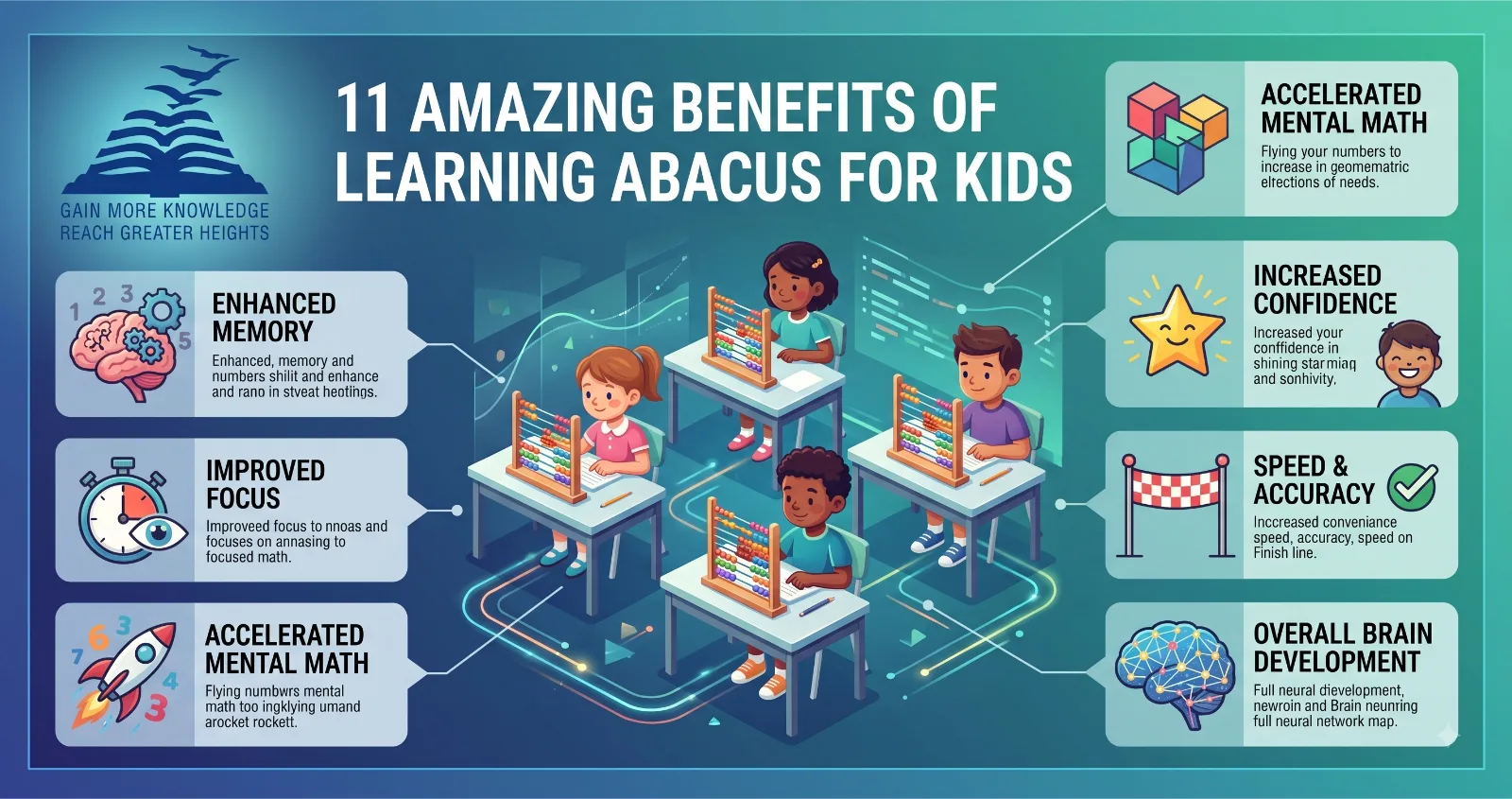
11 Benefits of Abacus Learning for Children
The Importance of Abacus lies in combining visual representation, coordinated movement and repeated calculation practice. Research has found particularly consistent improvements in trained arithmetic abilities, although broader cognitive outcomes can differ among children.
1. Builds a Strong Understanding of Numbers and Place Value
Each bead position represents units, tens, hundreds or higher values. This concrete structure helps children understand how numbers are formed and regrouped.
2. Improves Mental Calculation Skills
With practice, children learn to picture bead movements without using the physical instrument. This visual strategy can help them solve arithmetic calculations mentally.
3. Increases Speed and Accuracy in Arithmetic
Regular practice helps learners recall procedures and complete familiar calculations efficiently. Improved speed should develop after accuracy rather than becoming the only objective.
4. Strengthens Concentration and Attention
The Benefits of Abacus may include improved task-focused attention because children must listen carefully, remember numbers and coordinate several bead movements without losing their place.
5. Develops Working Memory and Information Recall
Learners temporarily hold numbers and intermediate answers while calculating. A longitudinal study found stronger arithmetic and visuospatial working-memory performance among children who received sustained mental-abacus training.
6. Enhances Visualisation and Spatial Thinking
One of the notable abacus advantages is that children eventually imagine the bead arrangement and mentally transform it as calculations progress.
7. Encourages Logical and Analytical Thinking
Children follow systematic rules, recognise numerical relationships and select the correct bead movements for different calculations.
8. Improves Problem-Solving Abilities
Abacus practice teaches learners to divide calculations into manageable steps, detect errors and try an alternative approach when necessary.
9. Develops Listening and Instruction-Following Skills
Oral calculation exercises require children to hear numbers accurately, retain their sequence and respond according to instructions.
10. Builds Confidence and Reduces Fear of Mathematics
Visible progress can make numbers feel less intimidating. Successfully completing progressively difficult problems encourages children to approach mathematics with greater confidence.
11. Encourages Patience, Discipline and Perseverance
The benefits of abacus classes can include stronger practice habits as children learn that improvement develops through repetition, correction and consistent effort.
What Is the Right Age for a Child to Start Learning Abacus?
Many programmes begin around five or six years of age, when children can recognise numbers and follow simple instructions. Readiness matters more than starting at a particular age.
Which Mathematical Operations Can Children Learn Using an Abacus?
Beginners usually start with counting, place value, addition and subtraction. Progressive programmes may later introduce multiplication, division, decimals, square roots and more complex calculations.
How Abacus Training Supports Classroom Learning
An abacus for students can reinforce arithmetic fluency and place-value concepts taught at school. It should complement classroom explanations, written methods and mathematical reasoning rather than replace them.
Abacus Learning Versus Conventional Mathematics Methods
Abacus instruction uses visual-spatial representation and bead movement, while conventional methods frequently rely on written symbols and verbal procedures. Children benefit from understanding both approaches and when to use them.
Does Abacus Training Benefit Subjects Beyond Mathematics?
Skills such as concentration and following instructions may support broader learning. However, evidence for transfer to unrelated subjects remains mixed, so parents should avoid claims that abacus training automatically improves every academic ability.
How Parents Can Support Abacus Practice at Home
Schools following the icse curriculum can encourage varied mathematical strategies, but regular home practice is necessary if a child is enrolled in a separate abacus programme.
Set a Short and Consistent Practice Routine
Ten to fifteen minutes of focused practice can be more manageable than a long, tiring session, particularly for beginners.
Focus on Accuracy Before Increasing Speed
Encourage children to understand each movement and check their answers before introducing timed calculations.
Encourage Progress Without Creating Pressure
Praise effort, consistency and improvement instead of comparing the child’s calculation speed with classmates or siblings.
How to Choose the Right Abacus Programme for Your Child
Parents comparing programmes associated with the best ICSE schools in Bangalore should examine teaching quality, progression and feedback instead of relying solely on competition results or promotional promises.
Check the Instructor’s Experience and Teaching Approach
The instructor should explain concepts patiently, recognise individual learning differences and avoid creating unnecessary performance pressure.
Choose an Age-Appropriate and Progressive Curriculum
Families exploring programmes near the top ICSE schools in RT Nagar should confirm that lessons progress logically from physical bead manipulation to visualised calculation.
Look for Interactive Practice and Individual Feedback
A suitable online abacus class should include live guidance, visible demonstrations, error correction and opportunities for the instructor to monitor each learner.
Common Misconceptions About Abacus Learning
Abacus training does not guarantee exceptional intelligence, photographic memory or excellence in every subject. Its strongest demonstrated outcomes relate to practised calculation and related visual-spatial processes.
Is Abacus Learning Right for Every Child?
Not necessarily. A randomised trial found that mental-abacus training improved arithmetic performance, but progress varied partly according to children’s spatial working-memory abilities. Interest, readiness and teaching quality should guide the decision.
Building Faster Minds Through Abacus Learning
Learning the abacus can do much more than improve calculation speed—it can strengthen concentration, memory, visualisation, number sense, and problem-solving ability in young learners. At Presidency School RT Nagar, students are encouraged to develop mathematical confidence through engaging, activity-based approaches that make numbers easier to understand and work with.
Abacus practice supports mental arithmetic by helping children visualise numbers, recognise patterns, and solve calculations with greater accuracy and focus. By combining strong academic foundations with interactive learning methods, Presidency School RT Nagar helps students build sharper thinking skills, greater confidence in mathematics, and learning habits that support success across subjects.
Conclusion
Abacus learning can make mathematics more engaging by helping children see, understand, and mentally process numbers in a structured way. Its strongest benefits are seen in arithmetic fluency, place-value understanding, visualisation, concentration, accuracy, and confidence with calculations. However, the real value of abacus training depends on age-appropriate instruction, regular practice, patient guidance, and realistic expectations.
Parents should view it as a supportive learning tool rather than a shortcut to overall academic excellence. When children are interested, ready, and guided by a well-designed programme, abacus practice can strengthen their relationship with numbers while also encouraging patience, discipline, and independent problem-solving.