
Your child can recite the definition of evaporation perfectly. But when you ask why wet clothes dry faster in the sun, they hesitate. Sound familiar? This everyday moment captures the debate around rote learning vs conceptual learning. One helps children remember information; the other helps them make sense of it. Both have a place in a child’s education.
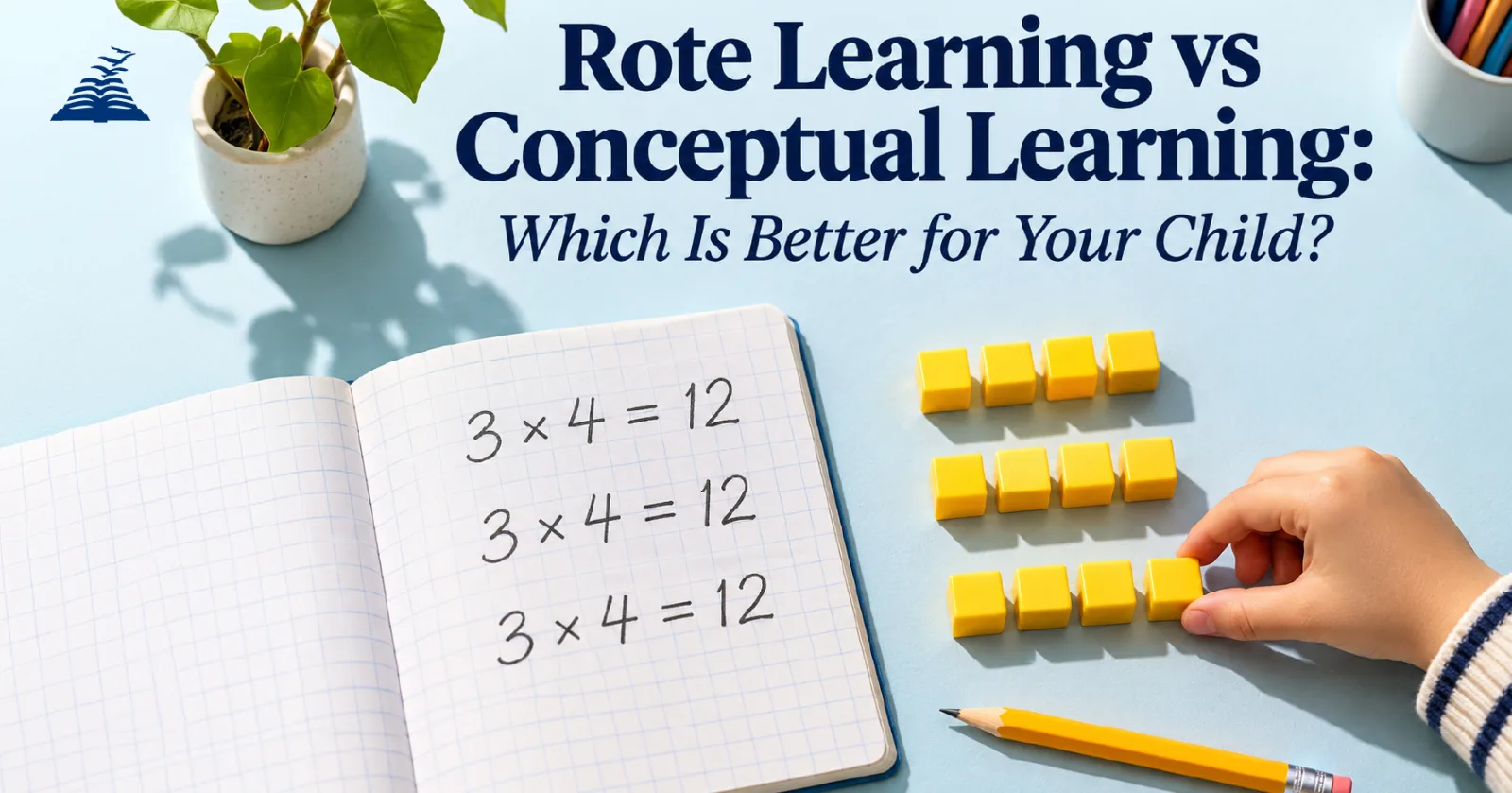
Table of Contents
Understanding Rote Learning and Conceptual Learning: Meaning and Examples
Children need to remember certain facts, but they also need to explain ideas and solve unfamiliar problems. Understanding the difference between these approaches helps parents guide homework and notice whether learning goes beyond repeating textbook answers.
What Is Rote Learning? Benefits, Limitations and Real-Life Examples
Wondering what is rote learning? Think of a child repeating multiplication tables, spelling words or historical dates until they can recall them quickly. Repetition is the main tool, even when the reasons behind a fact are not explored.
The advantages of rote learning include quick recall and confidence with familiar tasks. Knowing multiplication tables, for example, frees up attention for the harder steps in a mathematics problem.
The disadvantages of Rote Learning become apparent when children can repeat a definition but cannot explain it in their own words. Facts memorised solely for an exam may also be forgotten afterwards.
What Is Conceptual Learning? Benefits and Practical Examples for Students
So, what is conceptual learning? It means understanding how and why an idea works. Instead of memorising that sunlight helps plants grow, children observe two plants kept in different lighting conditions. In Mathematics, they explore why a formula works before applying it.
This approach builds curiosity and flexibility. It may take longer initially, but it helps students tackle questions that look different from those practised in class.
Key Differences Between Rote Learning and Conceptual Learning
Here is a quick comparison to help parents recognise each approach.
| Aspect | Rote Learning | Conceptual Learning |
| Main focus | Recall | Understanding |
| Method | Repetition | Discussion and exploration |
| Typical question | What is the answer? | Why does it work? |
| Strength | Fast access to facts | Applying ideas to new problems |
| Limitation | May miss deeper meaning | Often needs more time |
Neither approach should be measured by marks alone. Ask whether your child can explain a lesson using an example that was not in the textbook.
How Conceptual Learning Improves Critical Thinking, Problem-Solving and Long-Term Memory
Understanding helps children connect lessons to daily life. Fractions become easier to grasp when dividing a pizza or measuring ingredients. Science becomes meaningful when they can explain why an ice cube melts.
Questions such as “What might happen if…?” encourage predictions and reasoning. Linking new ideas with familiar experiences can strengthen memory, while mistakes reveal what still needs clarification. Children learn to investigate instead of guessing.
Can Rote Learning and Conceptual Learning Work Together for Better Academic Performance?
Yes. A child can memorise a multiplication table and still understand multiplication as repeated addition or groups of equal size. The goal is to combine fluent recall with meaningful application.
Try a simple sequence: explain a concept with an example, practise important facts, then attempt a new problem without notes. This makes revision more useful than reading the same page repeatedly, especially before examinations.
Practical Tips for Parents to Encourage Conceptual Learning at Home
Make learning part of ordinary conversations rather than another formal lesson. You can:
- Ask your child to teach you a topic in their own words.
- Connect percentages to shopping discounts and measurements to cooking.
- Encourage questions, including ones you cannot answer immediately.
- Praise thoughtful attempts, not just correct answers.
- Use quick quizzes after your child understands the topic.
When exploring an ICSE school in RT Nagar, ask how teachers use demonstrations, classroom discussions and feedback alongside textbook exercises. Specific examples are more useful than broad claims about teaching methods.
Families comparing top ICSE schools in Bangalore can look for projects, practical activities and chances for students to ask questions. At home or at school, the aim is the same: help children remember what matters and understand why it matters.
Presidency School RT Nagar: Transforming Knowledge into Meaningful Understanding
Education becomes truly impactful when children understand concepts rather than simply memorise information. Presidency School RT Nagar brings learning to life through experiential teaching, interactive classroom discussions, practical activities, and real-world applications. Its comprehensive ICSE curriculum encourages students to explore ideas, ask questions, and develop independent thinking. By emphasising conceptual clarity alongside academic excellence, the school empowers students to strengthen their problem-solving abilities, retain knowledge effectively, and confidently apply their learning beyond the classroom.
Conclusion
Understanding the difference between rote learning and conceptual learning helps parents choose effective approaches to their child’s education. While rote learning strengthens memory and quick recall, conceptual learning encourages critical thinking, problem-solving and deeper understanding. Combining both methods creates a balanced learning experience that supports academic performance and long-term knowledge retention. Parents and educators should encourage curiosity, practical application and meaningful discussions to help children develop confidence, independent thinking and essential skills for lifelong learning.