A school bus travels 12 kilometres in 30 minutes. A cyclist covers the same distance in an hour. Who is moving faster, and how can you prove it? Learning how to calculate speed distance and time helps students answer everyday questions using three simple formulas.
Whether you are solving a maths problem or estimating a journey, the starting point is the same: identify what you know and what you need to find.
Table of Contents
Understanding Speed, Distance and Time
The Relationship between speed distance and time describes how far something travels, how quickly it moves and how long the journey takes.
- Speed: The distance travelled per unit of time.
- Distance: The total length of the route travelled.
- Time: The duration of the journey.
For the same distance, a higher average speed means a shorter travel time. At a constant speed, travelling for longer means covering more distance.
Essential Formulas for Speed, Distance and Time
The speed distance time formula changes depending on the missing quantity. You need two known values to calculate the third.
Speed = Distance ÷ Time
To calculate speed starts with dividing the distance travelled by the time taken. Travelling 100 kilometres in two hours gives an average speed of 50 km/h.
Distance = Speed × Time
How to calculate distance involves multiplying speed by time. A vehicle maintaining 40 km/h for three hours covers 120 kilometres.
Time = Distance ÷ Speed
How to calculate time involves dividing distance by speed. Covering 150 kilometres at an average speed of 50 km/h takes three hours.
Choosing Consistent Units Before Calculating
Check that your units work together before substituting numbers. For an answer in kilometres per hour, use kilometres and hours. For metres per second, use metres and seconds.
| Quantity | Common units |
| Distance | Kilometres (km), metres (m) |
| Time | Hours (h), minutes (min), seconds (s) |
| Speed | Kilometres per hour (km/h), metres per second (m/s) |
Converting Kilometres to Metres and Hours to Minutes or Seconds
Remember these basic conversions:
- 1 kilometre = 1,000 metres.
- 1 hour = 60 minutes.
- 1 minute = 60 seconds.
- 1 hour = 3,600 seconds.
For example, 2.5 kilometres equals 2,500 metres, while 15 minutes equals 0.25 hours. Avoid treating 30 minutes as 0.30 hours: it is half an hour, or 0.5 hours.
Converting Speed Between km/h and m/s
Use these shortcuts:
- km/h to m/s: Multiply by 5/18.
- m/s to km/h: Multiply by 18/5, or 3.6.
For example, 72 km/h × 5/18 = 20 m/s. These conversions follow from one kilometre equalling 1,000 metres and one hour equalling 3,600 seconds.
How to Use the Speed, Distance and Time Formula Triangle
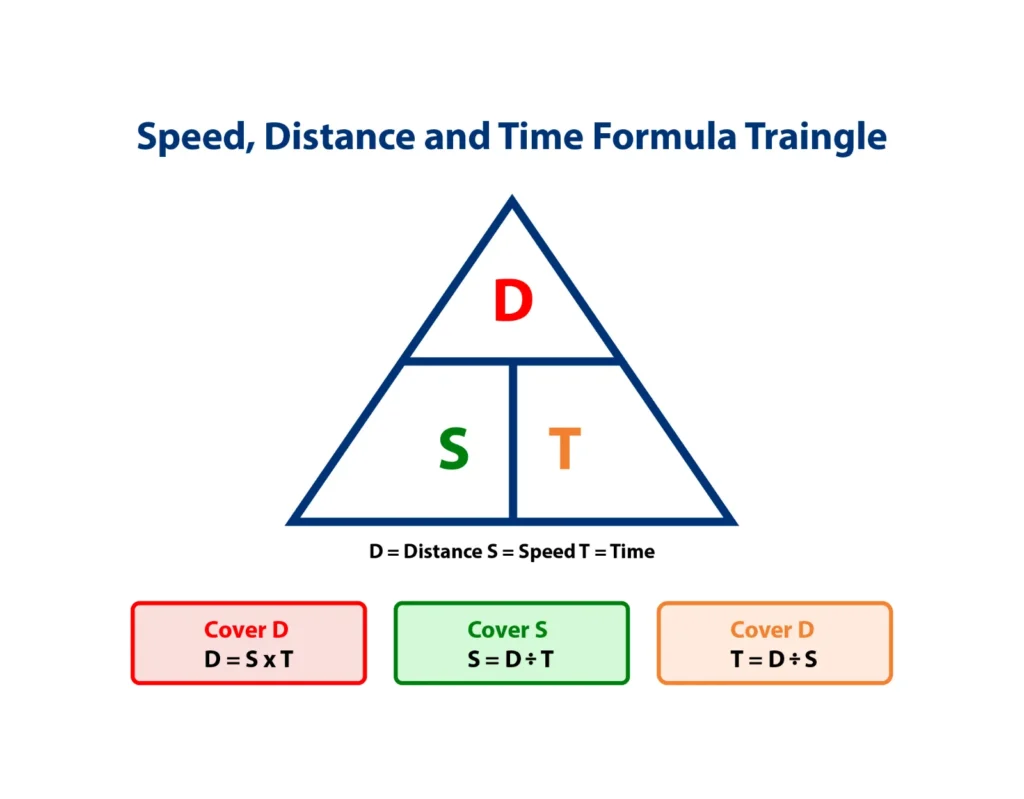
Imagine a triangle with distance at the top, speed at the bottom left and time at the bottom right. Cover the quantity you want to calculate.
| Cover this quantity | Operation remaining |
| Distance | Multiply speed by time |
| Speed | Divide distance by time |
| Time | Divide distance by speed |
The triangle is a memory aid. Always check your units and whether the answer makes sense.
Worked Examples: Calculating Speed, Distance and Travel Time
Example 1: Find speed. A cyclist covers 18 kilometres in 45 minutes. First, convert 45 minutes into 0.75 hours. Using the speed formula, average speed = 18 ÷ 0.75 = 24 km/h.
Example 2: Find distance. A train maintains 60 km/h for 90 minutes. Convert 90 minutes into 1.5 hours. Using the distance formula, distance = 60 × 1.5 = 90 kilometres.
Example 3: Find time. A student walks three kilometres at an average speed of 4 km/h. Using the time formula, time = 3 ÷ 4 = 0.75 hours, or 45 minutes.
Notice how converting time correctly makes each calculation easier.
How to Calculate Average Speed for a Complete Journey
Average speed equals total distance divided by total elapsed time. Include stops when calculating the average for the entire journey.
Suppose a bus travels 60 kilometres in one hour, stops for 30 minutes, then covers another 60 kilometres in two hours.
- Total distance: 60 + 60 = 120 kilometres.
- Total time: 1 + 0.5 + 2 = 3.5 hours.
- Average speed: 120 ÷ 3.5 ≈ 34.3 km/h.
Simply averaging the two travelling speeds would give the wrong result because the travel times differ and there is a stop.
Common Mistakes to Avoid in Speed, Distance and Time Problems
Watch for these common errors:
- Mixing kilometres with seconds without converting.
- Multiplying when the question requires division.
- Forgetting breaks in a complete journey.
- Confusing average speed with speed at one particular moment.
- Leaving units off the final answer.
- Rounding too early during a calculation.
Parents researching the good schools can ask whether maths lessons encourage students to explain these errors, alongside practising calculations.
Similarly, families considering top icse schools in rt nagar can look for opportunities to apply measurement through walking activities, sports and classroom investigations.
Practice Questions with Answers
Try solving these before checking the answers.
| Question | Answer |
| A car covers 180 km in 3 hours. Find its average speed. | 180 ÷ 3 = 60 km/h |
| A runner maintains 3 m/s for 40 seconds. Find the distance. | 3 × 40 = 120 metres |
| A bus covers 100 km at an average speed of 50 km/h. Find the time. | 100 ÷ 50 = 2 hours |
| Convert 54 km/h into m/s. | 54 × 5/18 = 15 m/s |
Make Mathematics Meaningful at Presidency School RT Nagar
Estimating a journey’s duration or comparing two runners’ speeds shows children how mathematics helps explain everyday experiences. Presidency School RT Nagar is one of the top ICSE schools in Bangalore encourages learners to connect subject knowledge with practical thinking, building their confidence in understanding and solving problems. Exploring speed, distance and time is one way students can see the purpose behind a formula. With an emphasis on academic understanding, curiosity and independent thought, the school helps young minds develop skills they can carry into further learning and daily life.
Conclusion
The bus in the opening example averages 24 km/h, while the cyclist averages 12 km/h. Comparing them becomes straightforward once both times are expressed in hours. Solving speed, distance and time problems follows the same approach: identify the missing quantity, choose the formula and use consistent units. For a complete journey, include all elapsed time when finding average speed. Practise explaining each step, then check whether your answer and its units make sense.