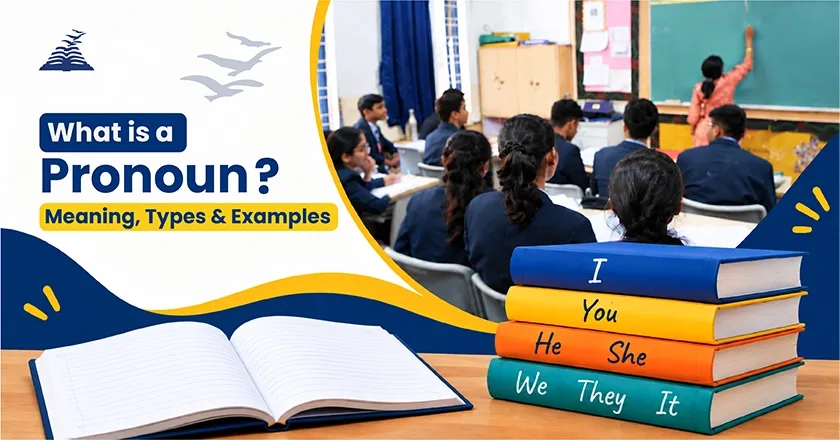
For anyone asking, “what is a pronoun?”, this small change offers a useful starting point. Pronouns help us refer to people and things without repeatedly naming them.
Example: “Ananya found a notebook. Ananya put the notebook in a bag.” That becomes easier to read as: “Ananya found a notebook. She put it in a bag.”
Pronoun Meaning and Definition with Simple Examples
To understand pronoun meaning, think of a word that can take the place of a noun or noun phrase. Pronouns can also refer directly to people or things understood from context.
For example:
- “The children arrived. They were excited.” Here, they refers to the children.
- “Please give me the pencil.” Here, me refers to the speaker.
A noun or noun phrase that a pronoun refers back to is called its antecedent. In the first example, “the children” is the antecedent of they.
Types of Pronouns and Their Uses in Sentences
Different types of pronouns serve different purposes. These nine commonly taught categories show how pronouns work in everyday sentences.
Personal Pronouns: Subject and Object Pronouns
Subject pronouns act as the subject of a verb. Object pronouns follow verbs or prepositions as their objects.
This short list of pronouns in English shows the matching forms:
| Subject Pronoun | Object Pronoun |
| I | me |
| you | you |
| he | him |
| she | her |
| it | it |
| we | us |
| they | them |
Example: “She called him.” She is the subject; him is the object.
Possessive Pronouns: Showing Ownership
Possessive pronouns include mine, yours, his, hers, ours and theirs. They stand alone: “That blue folder is mine.”
Compare “This is my folder.” Here, my comes before a noun, so it is a possessive determiner, often called a possessive adjective in school grammar.
Reflexive Pronouns: Referring Back to the Subject
Reflexive pronouns include myself, yourself, himself, herself, itself, ourselves, yourselves and themselves. They refer back to the subject.
Example: “Mira saw herself in the mirror.” Mira sees, and herself refers to the same person. Choose the form that matches the subject: “We introduced ourselves.”
Intensive Pronouns: Adding Emphasis
Intensive pronouns use the same forms as reflexive pronouns but add emphasis.
Example: “The principal herself presented the prize.” Removing herself leaves a complete sentence with the same basic message: “The principal presented the prize.” This emphatic use is also called the intensive use of reflexive pronouns.
Demonstrative Pronouns: Pointing to People or Things
This, that, these and those can point to people or things. This and that are singular; these and those are plural.
Examples: “This is delicious” and “Those are expensive.” In “Those shoes are expensive,” those comes before a noun and functions as a determiner.
Interrogative Pronouns: Asking Questions
Interrogative pronouns include who, whom, whose, which and what. They ask about people, ownership or things.
Examples include “Who rang the bell?”, “Which would you prefer?” and “Whose is this?”
Whom is an object form, especially in formal English: “To whom should I give this?”
Relative Pronouns: Connecting Clauses
Relative pronouns introduce clauses that identify or describe a person or thing. Common examples include who, whom, whose, which and that.
In “The student who won the quiz is my friend,” who connects the description to “the student.” Another example is “Here is the book that you requested.”
Indefinite Pronouns: Referring to Unspecified People or Things
Indefinite pronouns refer to people or things without identifying them precisely. Examples include someone, anyone, everyone, nothing, both and several.
“Someone is waiting outside” leaves the person unnamed. Pay attention to agreement: “Everyone is ready” uses a singular verb, while “Several are missing” uses a plural verb.
Reciprocal Pronouns: Expressing Mutual Actions
Each other and one another show actions exchanged between people.
“The teammates encouraged each other” means they gave encouragement to one another. “The teammates encouraged themselves” has a different meaning: they encouraged their own selves. Both reciprocal expressions can refer to two or more people.
Rules for Using Pronouns Correctly and Common Mistakes to Avoid
Using singular and plural pronouns correctly involves checking number, sentence role and meaning.
- Choose the correct case: “Rohan and I arrived,” but “The teacher called Rohan and me.”
- Make references clear: “Asha told Neha that she had won” needs clarification about who won.
- Avoid unnecessary apostrophes: write yours and theirs, never your’s or their’s.
- Distinguish its from it’s: “The dog wagged its tail”; “It’s raining” means “It is raining.”
- Recognise singular they: “Someone left their umbrella” is acceptable. With they, use “they are,” even for one person.
Create a revision sheet titled “pronouns definition and examples” and write an original sentence for each category.
Presidency School RT Nagar: Strengthening English Foundations Through Pronouns
Understanding what a pronoun is, its meaning, types, and examples helps students build clearer sentences and communicate more confidently in English. At Presidency School RT Nagar, grammar is taught through relatable examples, guided practice, classroom interaction, and activity-based learning that make concepts easier to understand and remember. From personal and possessive pronouns to demonstrative, relative, reflexive, and interrogative pronouns, students learn how these words make communication more natural and avoid unnecessary repetition. By strengthening grammar through meaningful application rather than rote learning, Presidency School RT Nagar helps learners improve writing, speaking, comprehension, and overall language confidence. Parents exploring the best ICSE schools in RT Nagar can ask how reading, storytelling and sentence-writing activities help children apply grammar confidently.
Conclusion
Pronouns may be small words, but they play a major role in making English clear, natural and less repetitive. By understanding personal, possessive, reflexive, intensive, demonstrative, interrogative, relative, indefinite and reciprocal pronouns, students can improve both sentence construction and everyday communication. Equally important is learning to match pronouns correctly with their antecedents, use the right subject or object form and avoid common errors such as unclear references or incorrect apostrophes. Regular reading, speaking and sentence-writing practice can make these rules easier to remember. Once students understand how pronouns function in context, grammar becomes less about memorising definitions and more about expressing ideas accurately and confidently.